
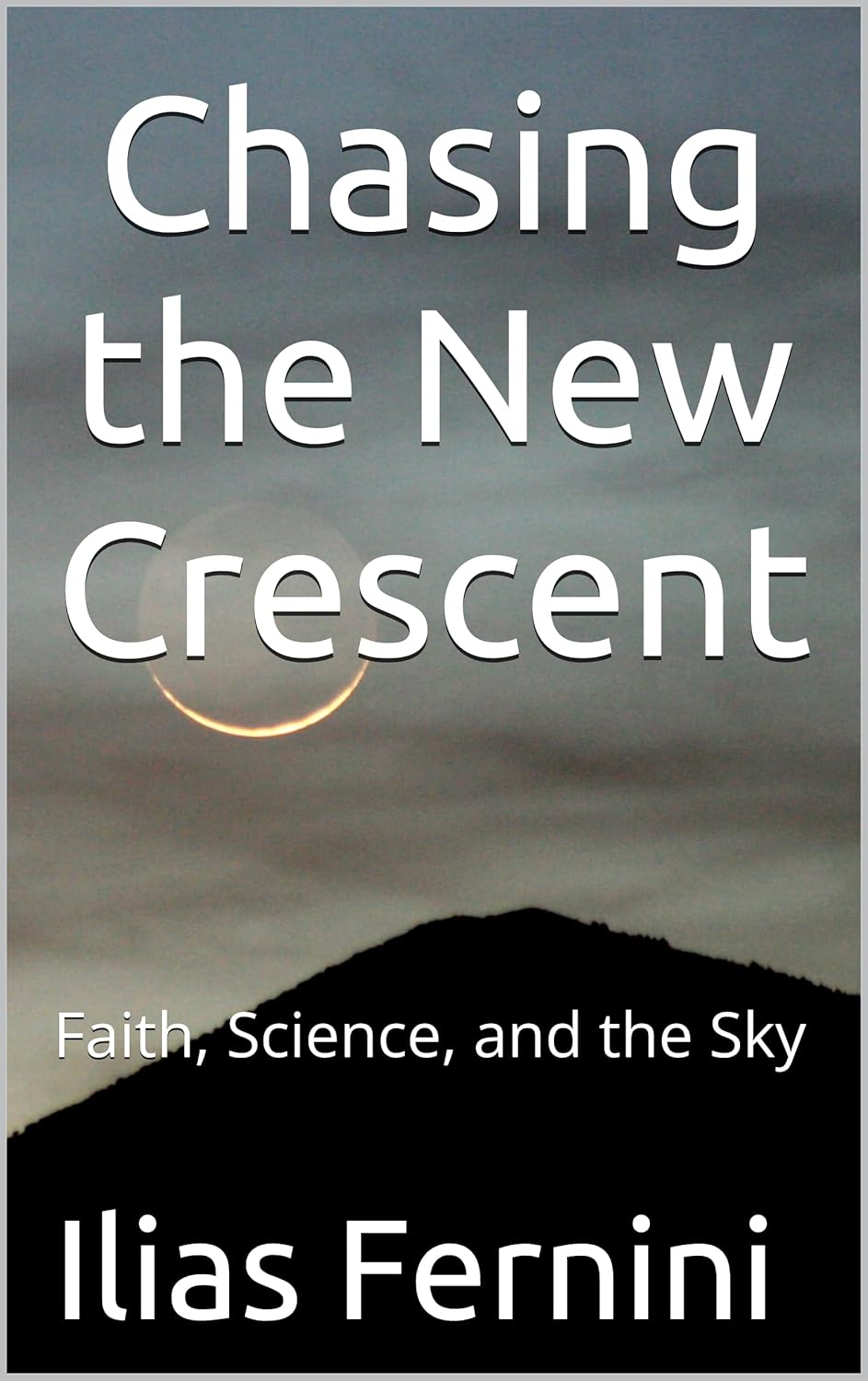
Chasing the New Crescent: : Faith, Science, and the Sky Kindle Edition
Product details
| Management number | 219242953 | Release Date | 2026/05/03 | List Price | US$90.00 | Model Number | 219242953 | ||
|---|---|---|---|---|---|---|---|---|---|
| Category | |||||||||
For thousands of years, humanity has looked to the first fragile curve of the new Moon as a signal of time, ritual, and wonder. But behind that faint silver arc lies one of the most captivating challenges in observational astronomy: When can the crescent be seen? And how have cultures across history attempted to answer that question?This groundbreaking book invites readers on an extraordinary journey through the science, tradition, and human experience of lunar crescent visibility—uniting disciplines rarely brought together in a single volume.Beginning with the earliest civilizations, the book traces how Sumerians, Babylonians, Greek astronomers, and early Muslim scholars all wrestled with the elusive first crescent. Their observations shaped calendars, rituals, and cultural rhythms for millennia. From ancient administrative records to sophisticated geometric models, the story of the crescent is revealed as a universal human endeavor—one that blends careful watching with evolving scientific insight.Readers then dive into the astronomical foundations of the crescent itself. Clear, engaging explanations illuminate the mechanics of lunar motion, illumination geometry, and the delicate interplay of Earth, Moon, and Sun that governs visibility. These chapters offer a masterclass in celestial mechanics made accessible to all.The book also provides a rich exploration of Islamic moon sighting, unpacking the religious, cultural, and legal traditions that continue to shape lunar-based observances today. It highlights the enduring significance of this practice and the modern questions communities face as science and tradition intersect.From there, the narrative travels through the evolution of modern visibility models, including a thorough examination of Yallop’s influential criterion. Readers witness how theory and observation meet, diverge, and continually refine our understanding of lunar visibility.Practical observers will find immense value in chapters dedicated to field techniques, atmospheric realities, and emerging technologies—plus a fascinating look into the frontier of daylight crescent sightings, where the boundaries of possibility are still being tested.The book’s carefully crafted appendices serve as a hands-on guide to lunar phases, perigee and apogee, New Moons, and observational nuances that enrich any skywatcher’s experience.Whether you are a student of astronomy, a participant in Islamic calendrical tradition, or simply someone who feels the pull of the night sky, this book offers a rare blend of scientific rigor, historical depth, and human meaning. Read more
Bestseller ranking
Hard-Boiled



Customers who viewed this product also viewed
Astronomy
![Sous les feux du Soleil: Vers une météorologie de l'espace (Grenoble Sciences) (French Edition) [Print Replica] Kindle Edition](https://m.media-amazon.com/images/I/41YddYo5ADL.jpg)
![Wndsn Quadrant Telemeters: Graphical Telemetry Computers: Low Tech Distance & Altitude Nomographs: Instruments for the Mastery of Time and Space [Print Replica] Kindle Edition](https://m.media-amazon.com/images/I/71W-CPszV9L._SL1500_.jpg)

Correction of product information
If you notice any omissions or errors in the product information on this page, please use the correction request form below.
Correction Request Form